Group Admits Mistake
Lolani Dalosa, Ken Faber, Lily Greig, Ton Ray, Rangi White
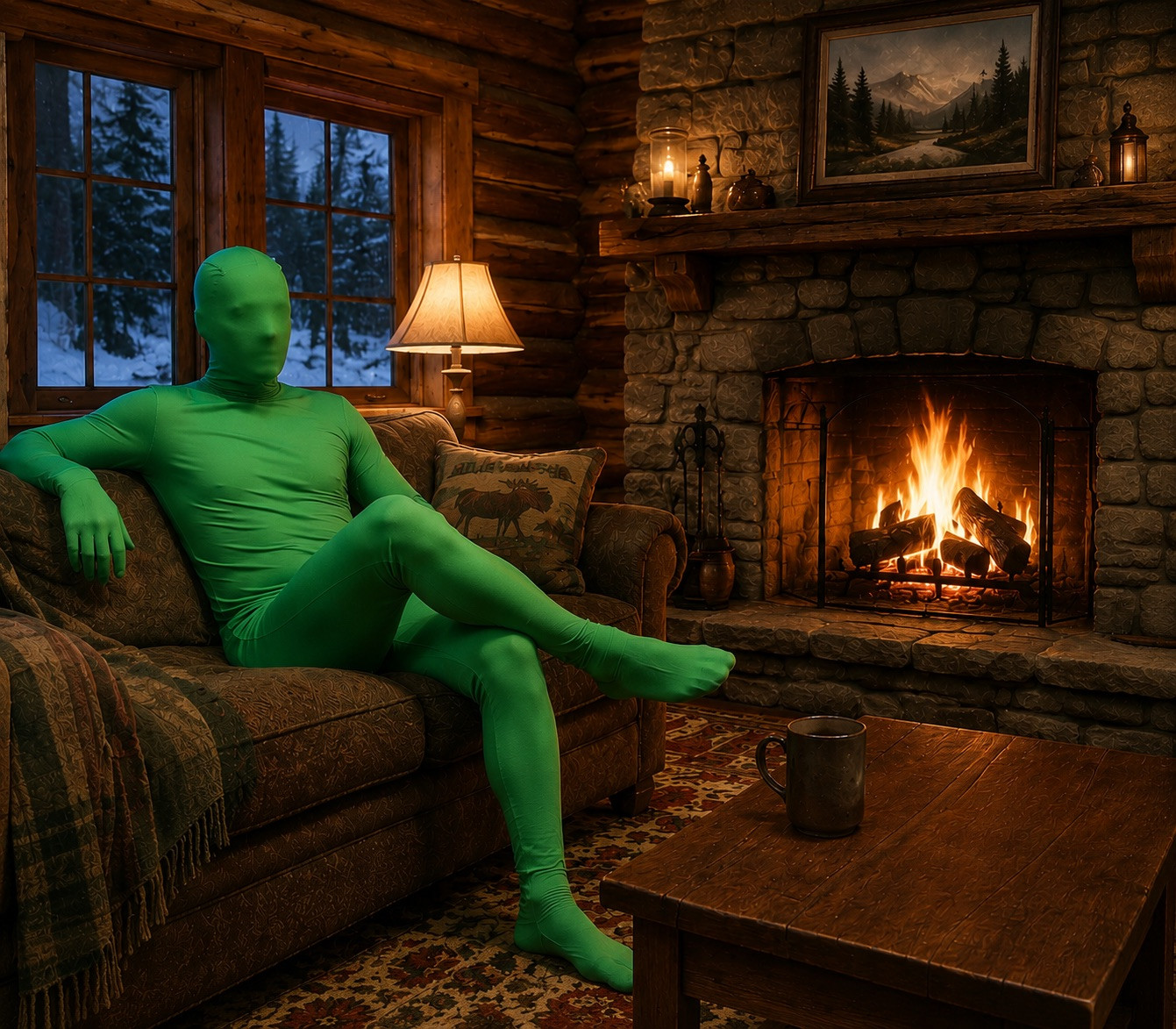
Ton Ray, Digital image, 2026.
How does a group form? The five Tāmaki Makaurau based artists in this exhibition were invited independently to make new art work. They have all produced semi-fictional worlds that raise questions about authority, participation, and meaning. Each of these worlds is interested in a process of transition. Cabins, shelters, underworlds, and purgatories introduce characters who experience uncertainty, misunderstanding, and boundaries. This exhibition asks what happens when we find ourselves part of a system we cannot fully understand or control.
This exhibition is presented with the support of our strategic partner the Chartwell Trust. The programme participants were also supported by The Karekare House Artist Residency and Eden Arts Trust.
After working with a demoralised, disorderly ward of neurotic soldiers at Northfield Hospital, Birmingham, during the Second World War, psychiatrist Wilfred Bion developed a theory of the group as an autonomous mentality with an unconscious of its own. 1 Groups, he found, are secretly organised by shared fantasies—the most telling being a longing not to work together, but to be saved. 2 On the threshold of becoming its true self, the group searches for a leader, an enemy or an exit, placing its authority anywhere but in the room.
Every work in this exhibition is built on a threshold. A permeable curtain, a bus stop, a portal, two extinction events and a group in a cabin who never quite form. Within them, characters step forward to test their frame, splitting themselves between the constructed world of the work and the structural reality of the gallery.
A trio flattened in an Auckland Transport bus stop reanimate a South Auckland waystation long watched by Lolani Dalosa. Shot, cut and mounted like photo-object props, these are subjects in transition, wavering between freedom of choice and indifference to it. In this diorama the withheld arrival of a redemptive vehicle gives way to what Cady Noland saw as a pernicious game: an arena of synthesised tactics “where advantage can be gained in an oblique way.”3
In a scene staged by Lily Greig, a free-standing door opens onto the Duat, the ancient Egyptian netherworld where the dead must pass through gates guarded by demons who grant entry only when named correctly. Here, door and demon form a union, the image charges the object that carries it, together they invoke an idea of sculpture not as ornament but as apotropaic object—a functional vessel that might act, not merely depict. Curled at the base, a not-yet-real boy with a Pinocchio nose feigns sleep, perhaps to defer judgement—but his growing nose gives away his fate.
Rangi White’s Rastafari metal chain curtain, remade in the vernacular of cool minimalist sculpture, delineates another threshold. One side draws on a history of cultural resistance sown on the East Coast—Ruatoria, Ngāti Dread, Aotearoa roots and the 1979 Bob Marley show at Western Springs that inspired them. The other enters a lineage of curtain-works staged in New Zealand art institutions, enveloping Ilse von Randow’s 1957 loom-woven commission for the Auckland Art Gallery through the artistic vocabulary of Artspace Aotearoa Kaitohu Director Ruth Buchanan. If Babylon, in Rastafari, denotes the order that absorbs whatever rises against it, this work anticipates that conclusion by taking on the idiom of an art-Babylon that will inevitably aestheticise it.
A grammar for that inevitability—the prophetic perfect tense—is found in the Bible, where events yet to happen are phrased as already finished. The future told in the past. Ken Faber works in this grammar. Across rimu-veneered doors, found curtains and taxonomic sculptures of bird feathers, sea glass and alpaca wool, Faber imagines worlds where native birds are spliced with their dinosaur ancestors. These chimeras create a loop between the extinction event that closed the Cretaceous period and the one underway now, in the Capitalocene.4 They circle a catastrophe still arriving and already decided.
Prophecy comes by way of a riddler in a surreal docu-fiction psychodrama by Ton Ray. Four strangers appear in a cabin, confused, unable to connect, assembled for a reason none can name. The sudden arrival of a godhead in a question-mark suit reprises what Bion observed: when a group cannot bear to be one, it conjures a redeemer. This oracle promises hope, but his muffled, cryptic answers exacerbate the chaos. The group tries to reify him and discover their purpose, but as they fail, the camera turns on them. It reveals the apparatus of the film’s own making and recasts the group as administrators of its meaning.
Bleeding into one another through narrative and matter, these planes produce a type of spectatorship, one that moves by metalepsis: in and out of fiction, between worlds and through the surreality of the institution they occupy. As each scene shuffles authority elsewhere—to the next bus, gate, institution or epoch—a spectator appears just in time: messiah, administrator of meaning.
-
Wilfred R. Bion, Experiences in Groups and Other Papers (London: Tavistock, 1961). A collection of papers written between 1943 and 1952, starting from the Northfield experiment with John Rickman, continuing with therapy groups at the Tavistock Clinic. ↩
-
Ibid. 151. Bion argues that a group's efforts at its actual task are covertly steered by ‘basic assumptions’: dependency, fight-flight and pairing. In pairing, the group hopes that two of its members will produce a saviour, a hope that depends on the saviour never arriving: “Only by remaining a hope does hope persist.” ↩
-
Cady Noland, Towards a Metalanguage of Evil, ed. Roland Nachtigäller (Stuttgart: Edition Cantz, 1992). Noland argues that American social life is organised around sanctioned ways of treating people as objects, with the game as its model. ↩
-
Jason W. Moore, Capitalism in the Web of Life: Ecology and the Accumulation of Capital (London: Verso, 2015). Moore's ‘Capitalocene’ places responsibility for the current ecological crisis not on humanity in general (the Anthropocene) but on capitalism's organisation of nature since the sixteenth century. ↩
Biographies
-
Lolani Dalosa is a Samoan and Filipino artist based in Tāmaki Makaurau. Using CCTV material, online imagery, industrial and readymade objects, Dalosa produces films, sculptures, photographs and installations drawn from urban life in South Auckland. These constitute an ongoing study of ambivalence, examining the underlying determinants of choice, engagement and participation within everyday structures and systems. Recent projects include Spades, 2026, Aotearoa Art Fair; Slow Races Nowhere, 2025, Nathan Homestead; Dalosa, Lafo & Iva, 2025, The Physics Room; and Character Studies, 2024, Te Tuhi.
-
Ken Faber is a painter and sculptor whose work draws on deep time, prehistory and extinction to rethink present-day system collapse. In recent works, chimera avian species—native birds grafted with dinosaur ancestors—face impending meteors. Egg tempera is posited here as a 'non-binary' emulsion of oil and water, suggesting a genderqueer transcendence of the binaries underpinning the Capitalocene. Drawing on Biblical grammar, Faber reads unconscious fantasies of extinction in the 'prophetic perfect tense': a crisis at once arriving and already decided. They completed a Bachelor of Fine Arts and Anthropology at the University of Auckland in 2025 and are currently completing a Bachelor of Fine Arts Honours.
-
Lily Greig is an artist based in Tāmaki Makaurau, working across sculpture and installation. Her work draws on the way archetypes are used in psychoanalysis to understand and resolve defensive responses to trauma. Incorporating Egyptian magico-religious texts, the Cult of the [decapitated] Head in Iron Age Europe, and the tradition of bodily relics in Catholic material culture, Greig's practice recalls archaic modes of meaning-making through objects. She completed a Bachelor of Fine Arts at Elam School of Fine Arts in 2025.
-
Ton Ray is a filmmaker and visual artist based in Tāmaki Makaurau. His work tests the limits of non-teleological narrative and world-building in still and moving images. Using repetition, recursion and micro-variation, he constructs worlds in which time is fragmented and events are connected not by causality but by recognition and memory. Alongside his moving-image work, Ray maintains a sculptural practice that uses found photographs and frames to reorganise borders and recontextualise them. He holds a Master of Fine Arts from Elam School of Fine Arts, 2023 and, in 2024, founded Strawhouse, an artist-run space in Mount Eden.
-
Rangi White of Rongomaiwahine is a sculptor and installation artist based in Tāmaki Makaurau. He has exhibited at Gus Fisher Gallery, Treadler, Ivan Anthony and William Austin. He holds a Master of Māori Studies from Waipapa Taumata Rau, University of Auckland.
Events
Artist talk with Ken Faber, Lolani Dalosa and Rangi White
Artist talk
Publication launch: The Purpose of the Space Is What It Does
What writing do we need? New Commissions Writers publication launch
Deep dive: Lecture by Kaiāwhina Whakaaturanga Assistant Curator Matthew Hanson
Lecture: Monuments with Hamza Walker
In focus: A Curatorial workshop with Hamza Walker
2026 programme
Each year Artspace Aotearoa asks one question. Across the year, this question is explored by artworks, artists, and audiences. In 2026, we ask, “which history?” You can think of our annual exhibition programme as a connected inquiry, in four parts and with many possible answers. Join us.
Gordon Bennett
Emily Karaka
Selina Ershadi
Atarangi Anderson & Thies Vaihū
Margaret Aull
Elvis Booth-Claveria
Chris Bryant-Toi
Fiona Connor
Millie Dunstall
Jef Geys
Pākāriki Harrison
Abigail Aroha Jensen & Emil Scheffmann
Keciano
Georgia Larkins-Tareha
Lana Lopesi
Alex Martinis Roe
Andreas Müller
Liam Philp
Samoa House Library
Te Wānanga o Aotearoa
Sam Thorne
Nathan Wilson
et al.
Lolani Dalosa
Ken Faber
Lily Greig
Ton Ray
Rangi White