Which history?
Each year Artspace Aotearoa asks one question. Across the year, this question is explored by artworks, artists, and audiences. In 2026, we ask, “which history?” You can think of our annual exhibition programme as a connected inquiry, in four parts and with many possible answers. Join us.
View full programme text
Each year Artspace Aotearoa sets one question which our exhibitions and events orbit in the company of artists and audiences. Across the year, we explore what this question offers us and what artworks and their authors can weave together. In 2026, we ask “which history?”
In her essay “Twitch” Tina Makereti begins with an early childhood memory, where questions about “where do I come from?” lead her to go out into the dark night with her father and study the moon. Folding this memory into her now decades of lived experience she clarifies the consideration: “The internal world: the external world. How do we know our place in the universe?” 1 She answers this question with the word whakapapa. The essay goes on to unfold whakapapa as a practical, poetic, and embodied framework to consider and equally discover ourselves in the world. This unfolding of whakapapa enlivens a sense of time—and therefore also history—as something that does not happen to us, but something we are braided into as co-creators. In this paradigm we are both receptacles and actors who move within an arena. Whakapapa provides a dynamic and Aotearoa-specific lens to consider this toggling between actor and receptacle within society. This toggling activates the consideration: how can I act fully toward my place in time? How can I act in lively conversation with history?
Being ‘in time’ in the embodied way that whakapapa encourages is also a way of describing context. That is to say, what are the circumstances that impact the environment in which I find myself and my capacity to understand that? As a leading forum and platform for contemporary art, Artspace Aoteaora must necessarily scrutinise its own context, the arena and the frameworks in which it operates. Since 2023 we have approached one question at a time to do this, drawing a line between the work we do, artists who inspire, artworks that catalyse, and the world in which we live. So far we have probed three areas of life: body, territory, and language. Each of these areas came with their own conventions and boundaries that encircle much of daily life: assumptions around private and public space, division of labour, and which words are used where. These very same conventions, established over time and through repetition, play a significant role in our individual capacity to participate in our context.
These conventions are deeply bound to and informed by history. They span the what, how, and who of documenting and sharing ritual, experiences, and lives. In asking "which history?” we test history as an open form, insisting—like many other forms—that it is malleable, with multiple versions, available for interrogation by artists, writers, critical thinkers, and indeed, our organisation. After all, nothing is ever really closed, not even history. Our programme approaches the paradox of history: the certain value of standardised operations and methods within Western frameworks at the same time as exploring the friction, the jouissance, that the expanding of tones and tenors, bring to bear. In the 2026 programme we tackle Indigenous sovereignty and the colonial experience; so-called minor histories; art education—arguably the crucible of the contemporary art context and perspectives from emergent artists working in Tāmaki Makaurau today. Across 2026, we also consider the organisation’s legacy and the metaphorical and physical ways we can reconsider our own standards of behaviour.
At the heart of Yolande Zola Zoli van der Heide’s November 2025 lecture That Time You Were Not There 2 was that as artists, curators, writers, and other engaged society members it is essential to understand that “our horizon is not the institution. It is elsewhere, and otherwise.” Implied in the consideration of “which history?” is a sister question that expands the horizon, bends it ever so slightly: “which future?” Through an intergenerational programme of activity that includes painting, performance, film, sculpture, workshops, tours, symposium, and much more, we scratch into both sides of the temporal coin, seeking out continuity rather than fragmentation.
If the Artspace Aotearoa mission is to explore contemporary life, led by artists, it feels timely in a world characterised by tumult and an ever flattening of nuance to look at how we got here. The 2026 programme invites audiences to engage through a holistic lens that includes the deep ungraspable time of spiralling whakapapa, that moon gazed at by a young child, our current moment, and where we see ourselves tomorrow and beyond. In asking “which history?” Artspace Aotearoa casts out a hopeful call to the endless possibility for the critical and creative imagination to play an essential role in shaping what comes next.
Kaitohu Director, Ruth Buchanan
January 2026
Bibliography
Rachel Buchanan. Te Motonui Epa (Wellington: Bridget Williams Books, 2022).
Annie Ernaux. The Years (London: Fitzcolorado, 2018).
Carl Mika. Indigenous Education and the Metaphysics of Presence:
A Worlded Philosophy (Oxfordshire: Routeldge, 2017).
Diane di Prima. Revolutionary Letters. (London: Silver Press, 2021).
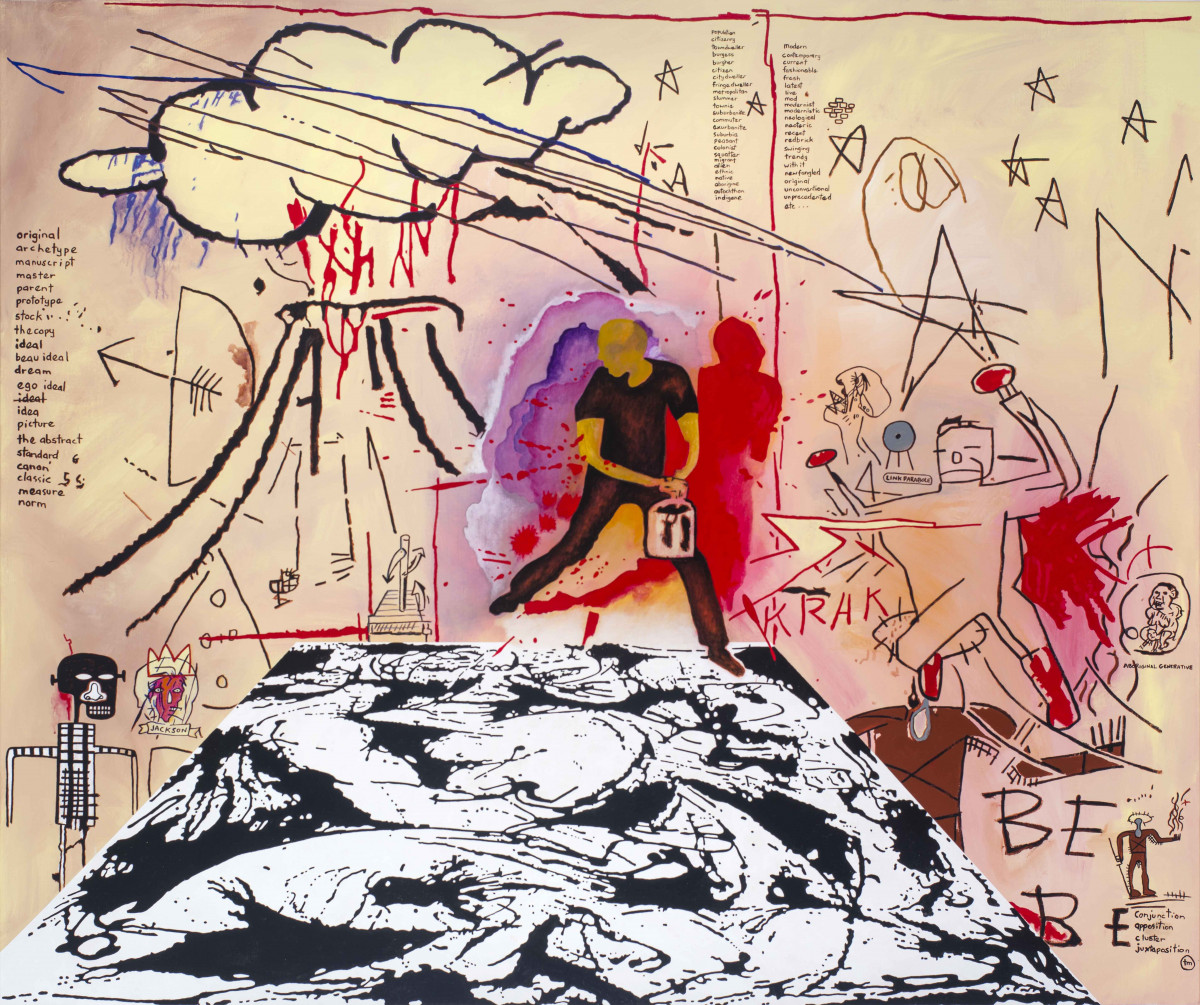
Gordon Bennett
Emily Karaka
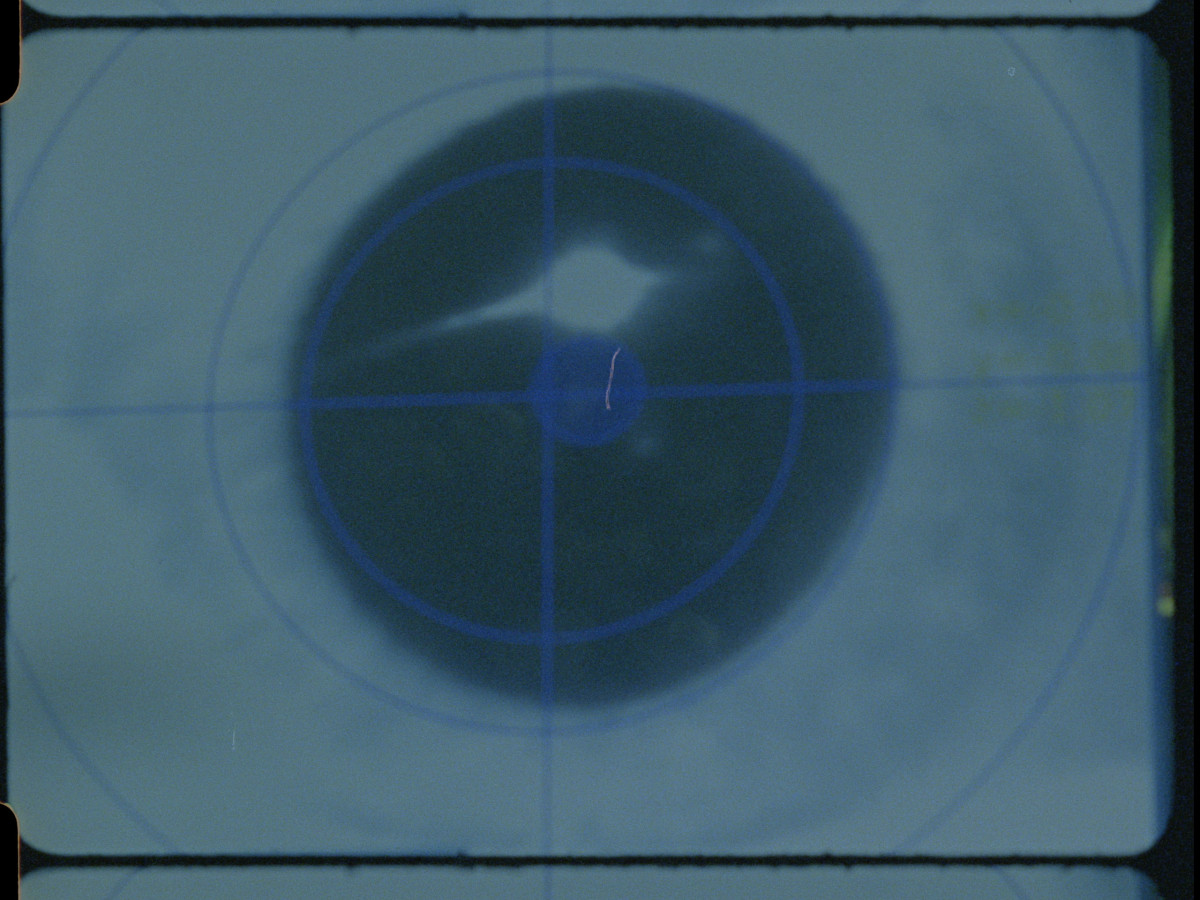
Selina Ershadi
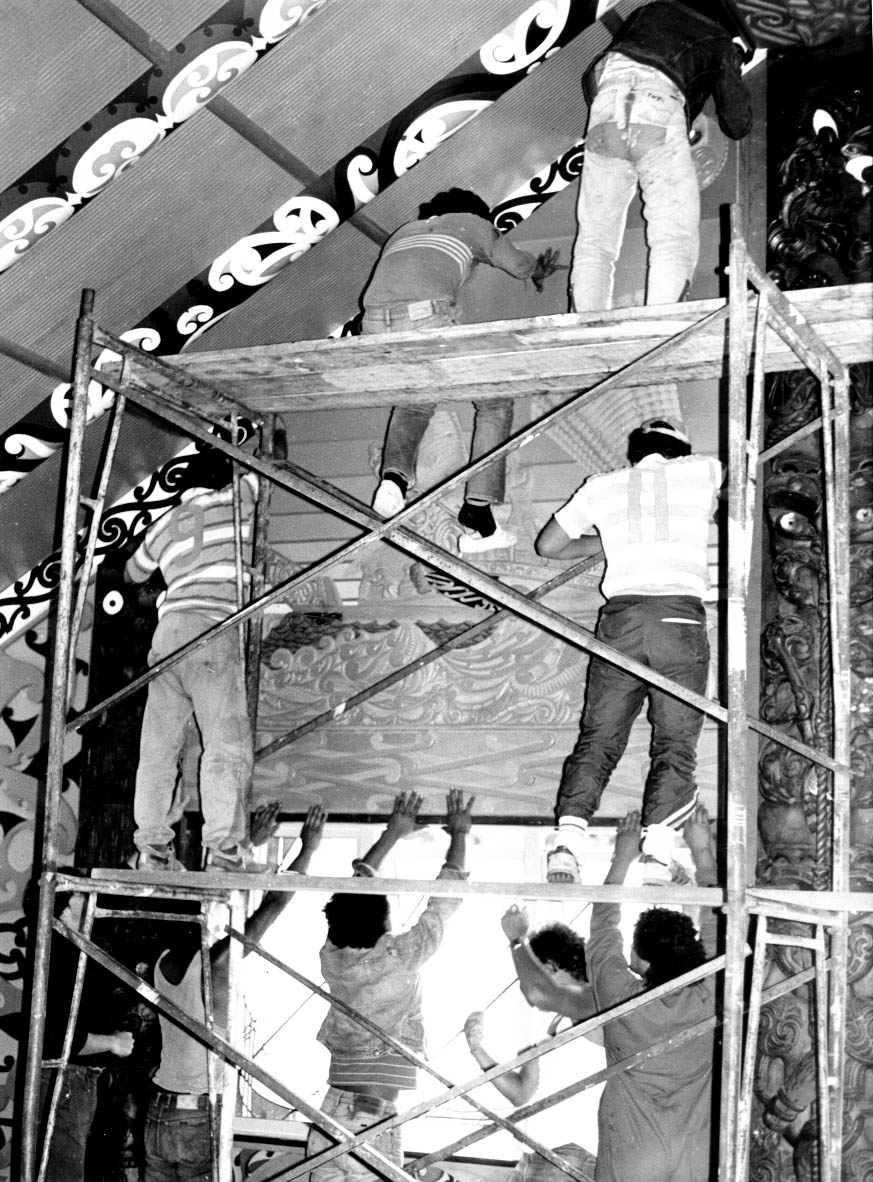
Atarangi Anderson & Thies Vaihū
Margaret Aull
Elvis Booth-Claveria
Chris Bryant-Toi
Fiona Connor
Millie Dunstall
Jef Geys
Pākāriki Harrison
Abigail Aroha Jensen & Emil Scheffmann
Keciano
Georgia Larkins-Tareha
Lana Lopesi
Alex Martinis Roe
Andreas Müller
Liam Philp
Samoa House Library
Te Wānanga o Aotearoa
Sam Thorne
Nathan Wilson
et al.
Lolani Dalosa
Ken Faber
Lily Greig
Ton Ray
Rangi White